In a Magellanic expedition without fiber, Starlink costs around $180,000 per month, and it’s the quickest option to install. A point-to-point link is suitable for connecting two owned sites with a clear line of sight. Fiber is only justified if the existing route already passes nearby. Most people end up using Starlink as their primary connection.
A job in Magellanic Patagonia rarely comes with reliability. What it often does have is a satellite phone for emergencies, and a router with a SIM card that sometimes works perfectly, and other times not at all. The question that reaches Ditap Industrial isn’t “what’s the best,” but “what allows me to work every day, without relying on the weather or luck.”
The three options, in practice
There are three paths, and it’s rarely used to follow just one.
| Option | Reference cost | Installation time | When is it advantageous? |
|---|---|---|---|
| Starlink managed. | From $180,000 per month | 1 day, with available energy. | Un connectionless network; an alternative for sites without terrestrial connectivity. |
| Direct link | Based on the project, according to distance and towers. | Two to four days | Connecting two of your own locations with a clear line of sight, when one already has a strong connection. |
| Fiber | As per the project’s specifications. | The length of time depends on the situation. | Only if a third party’s line comes very close to the location. |
The values represent historical references from an internal survey conducted on September 14, 2026. The sample and methodology are not included, and these values do not constitute a verified market comparison. The DITAP-managed service is not equivalent to the direct rate offered by the operator; it is necessary to confirm what is included in the proposal.
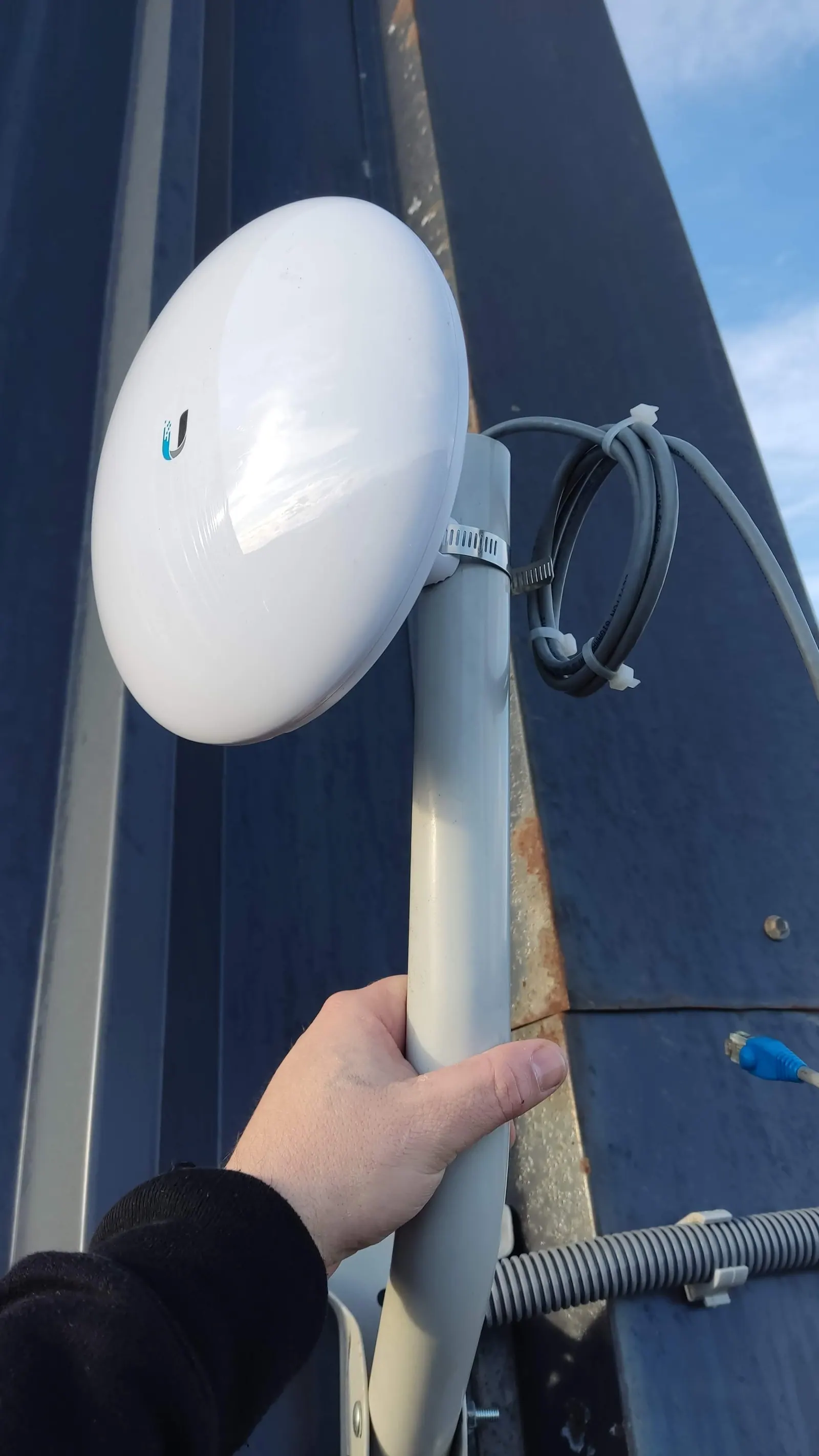
In practice, the fiber optic cable is hardly visible: laying kilometers of one’s own fiber is only justified if there’s already an existing third-party connection nearby – something relatively rare outside of Punta Arenas. While point-to-point connections are regularly used, they are employed as a complement to Starlink, rather than as a replacement: they are used to connect the main building’s connection, which uses Starlink, to a second structure associated with the same project, which is visible but lacks a direct internet connection.
What changes with snow and wind.
The selection and installation of the equipment must consider the site’s snow and wind conditions, within the specifications of the model. The climate, obstructions, and supplier can also impact the connection. However, the installation itself is what fails – an antenna that’s poorly anchored or oriented loses signal long before the equipment itself malfunctions. That’s why a preliminary visit is essential: we check the line of sight, assess the power source, and determine where the antenna will be positioned and protected before doing anything.
With point-to-point links, a similar thing happens: the distance they can handle on paper is greater than the distance they actually manage when there’s snow accumulating on the towers or vegetation growing between the points. We measure the actual line of sight, not the one shown on a map.
When is it advantageous to implement a failover?
Automatic failover – switching providers without anyone noticing – makes sense when the operation absolutely cannot be offline for even a minute: for example, with camera monitoring, telemetry, or a shift that relies on reporting progress. If the operation can wait for someone to identify the outage and call, using a single managed provider is sufficient and less expensive. We determine this together with the client during the visit, rather than presenting it as a purely sales-driven solution.
How much bandwidth does a task require?
Not every project requires the same level of resources, and overspending can add up significantly each month. A structure with two or three devices, email, and occasional video calls can be managed with a basic plan. However, a project involving continuous camera monitoring, multiple simultaneous connections, and equipment telemetry will require a more advanced plan, or even two parallel connections to distribute the load. Before signing up for a service, it’s important to list exactly how the connection will be used every day, not just in the most optimistic scenario, because a connection that’s overloaded during peak hours will eventually be perceived as “slow,” even if the contracted plan is suitable for lighter use.
What to ask before hiring.
- Does the price include the management and monitoring of the link, or only the equipment itself?
- Who checks to see if the signal degrades before it completely cuts off?
- What if the location changes, as it does on a mobile operation?
- Does the installer know the area, or is this their first time accessing that particular zone?
These four questions differentiate between a provider who installs equipment, and one who manages a connection. Remote connectivity We detail what each installation includes, with pricing from and the complete process, from the initial visit to ongoing monitoring.
The original article is retained. Prices and commercial terms are valid as of the date of publication and require confirmation before entering into any agreement.
Frequently Asked Questions
Does Starlink perform well if used for an entire day’s work?
The business plan is designed for continuous use. What needs to be determined is how many devices and cameras are sharing that connection, to avoid overloading it.
Does a point-to-point link replace Starlink?
Only if there’s a clear line of sight between the two locations and one of them already has a good connection for sharing. Otherwise, Starlink remains the best option.
What happens if the main connection is cut?
With failover configured, the second provider comes online without anyone noticing. Without failover, someone has to realize and call to inform others.
How long does it take to install Starlink in a field/work site?
One day, if there’s available power and the antenna location has already been determined, the installation visit is usually coordinated alongside the diagnostic visit.